2026 Bathroom Design Trends in Vancouver, WA: What Clark County Homeowners Are Choosing
Bathroom design trends for 2026 in Vancouver, WA are moving decisively away from the cool, all-white, minimalist bath that dominated the last decade. Clark County homeowners are choosing warmer palettes, curbless wet rooms, brushed brass and aged bronze fixtures, curved organic shapes, and biophilic details that connect the bathroom to the Pacific Northwest landscape outside the window. This guide covers the eight trends defining 2026 PNW bathroom remodels, what each looks like in practice, how they respond to our region's humidity and winter light, and how much they add to a Vancouver-area bathroom budget.
Planning a Bathroom Remodel?
Want to incorporate 2026 design trends without chasing short-lived fads? Our Vancouver, WA design team helps Clark County homeowners select finishes and layouts that look current today and still feel fresh a decade from now.
Request a Free ConsultationKey Takeaways
- Biggest shift: Moody and nature-inspired palettes replacing the all-white bathroom — moody palettes grew from 8% to 23% of remodels between 2020 and 2025 (Houzz)
- Top features: Curbless wet rooms, spa-style statement showers, heated floors, smart toilets, and warm brass fixtures
- PNW angle: Biophilic design reads especially well in the Pacific Northwest — windows, plants, stone, and reclaimed wood connect the bathroom to the forested Clark County landscape
- Climate-smart: Vancouver's 150+ rain days (NOAA, 2025) demand ventilation, moisture-rated finishes, and strong lighting to offset low winter daylight
- Cost impact: Trend-forward finishes add 10–20% over basic-grade selections in a mid-range remodel
1. Biophilic design and natural materials
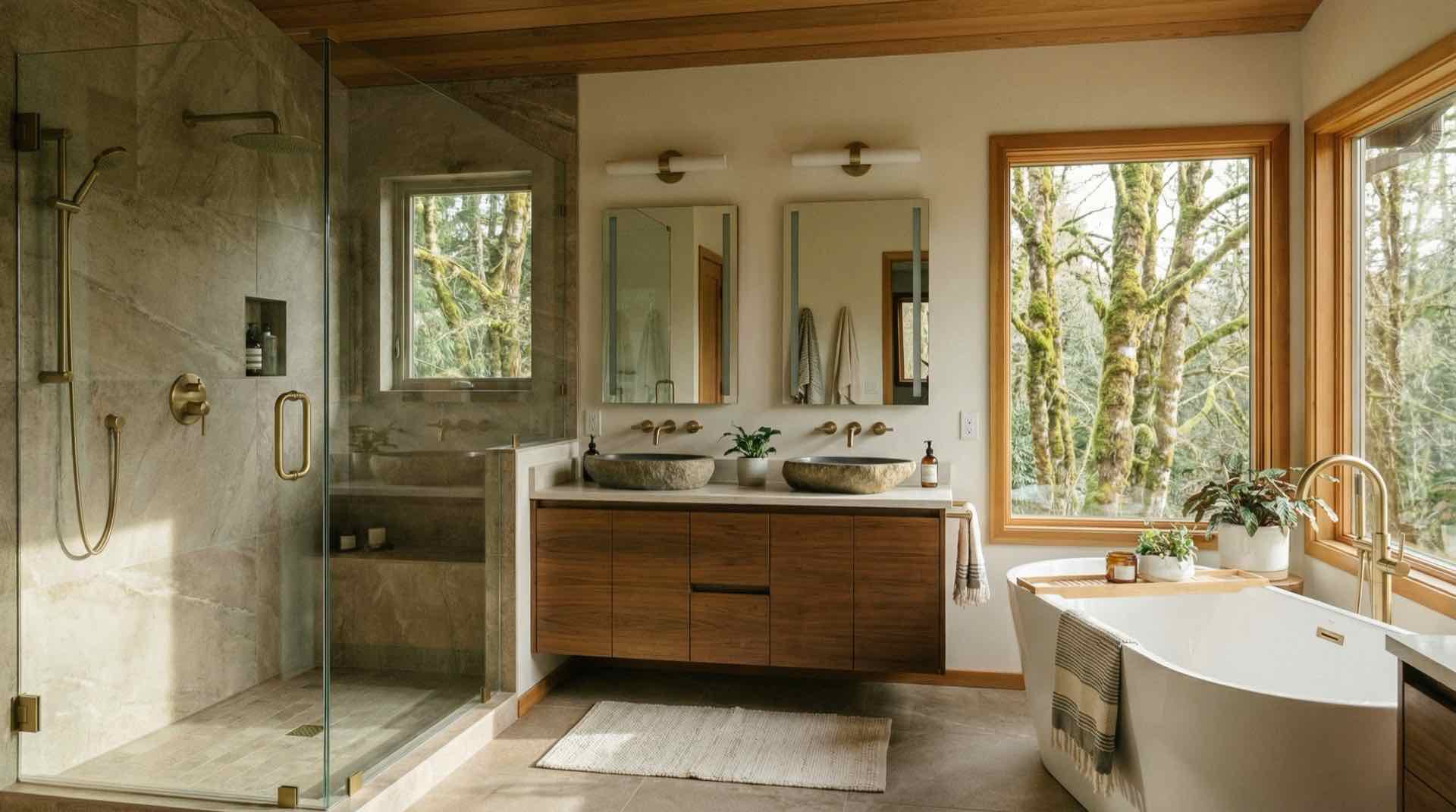
Biophilic design — bringing nature into the built environment — tops the 2026 NKBA Design Trends report as the most influential force shaping bathroom remodels. For Vancouver, WA homeowners, that means windows framed to capture tree views, living plants integrated into the bathing space, reclaimed wood vanities, live-edge shelving, and natural stone that showcases its veining and movement.
What biophilic bathrooms look like in practice:
- Expanded windows and skylights: Upgrading a small, frosted window to a larger privacy window or adding a solar tube floods the bathroom with daylight. This is especially valuable in the PNW where winter daylight is scarce. Budget $1,800–$4,500 for a window enlargement or $1,500–$3,000 for a solar tube.
- Living green walls and plant shelves: Humidity-loving plants (pothos, ferns, snake plant) thrive in a well-ventilated bathroom. Dedicated plant shelves near the shower or a compact green wall add life at modest cost.
- Reclaimed or live-edge wood: A floating vanity in reclaimed Douglas fir or a live-edge walnut shelf adds warmth and regional identity. Pair with marine- grade sealers for moisture resistance.
- Natural stone with visible grain: Honed slab backsplashes, pebble shower floors, and veined quartzite vanity tops are the 2026 answer to painted drywall and plain subway tile.
Photo guidance: Picture a floor-to-ceiling window over a freestanding tub with a Japanese maple visible outside, a reclaimed-wood floating vanity, a honed green marble slab backsplash, and a row of trailing plants on a wood shelf. That's the 2026 biophilic look.
Bathroom Color Palette Choices — 2020 vs. 2025 (Houzz Data)
Source: Houzz Bathroom Trends Study, 2020 and 2025. Percentages approximate.
2. Moody dark palettes and warm neutrals
The cool, bright-white bathroom is losing ground fast. In its place: saturated greens, deep navy, warm terracotta, chocolate brown, mushroom taupe, and earthy off-whites. The 2025 Houzz Bathroom Trends Study found that 23% of renovating homeowners chose moody or dark palettes, nearly triple the 2020 rate. In the Pacific Northwest, sage and forest greens are especially popular because they echo the region's Douglas fir and cedar landscape.
How PNW homeowners are using moody color in 2026:
- Painted vanities as accent: A forest green or matte black vanity against warm white walls and wood accents. Lower commitment than painting the whole room.
- Tile to the ceiling: Floor-to-ceiling tile in a moody tone (deep green zellige, navy handmade ceramic) creates an enveloping, spa-like wrap.
- Warm white with dark grout: For homeowners who want brightness with depth, white tile with charcoal or warm taupe grout adds graphic contrast without going full moody.
- Warm neutral drenching: “Color drenching” — painting walls, ceiling, and trim in the same warm neutral (mushroom, warm greige, soft clay) — is a defining 2026 move.
PNW lighting note: Vancouver, WA averages just 2–3 hours of direct sunlight in December (NOAA). Moody palettes work here only with strong layered lighting: vanity sconces at face height, recessed lights over the shower, and ideally a dedicated light fixture above a freestanding tub. Our recessed lighting installation cost guide covers the bathroom lighting upgrades that make dark palettes feel intentional instead of cave-like.
3. Curbless wet rooms and zero-threshold showers
The wet room — a bathroom where the shower has no curb, door, or separate floor plane and water drains through a linear floor drain — is one of the biggest shifts in 2026 bathroom layout. AIA's 2025 Home Design Trends Survey flagged curbless showers and wet rooms as a fast- rising feature, driven by three factors: the universal- design/aging-in-place movement, the desire for an open and spa-like feel, and the visual appeal of seamless tile floors.
What makes a proper wet room:
- Full waterproof membrane: The entire floor and lower walls are waterproofed before tile goes down (typical systems: Schluter-Kerdi, Laticrete Hydro Ban, or sheet membrane).
- Linear drain and sloped floor: The tile is sloped toward a linear drain (often placed along a wall). A trench drain keeps large-format tile possible, which small square drains don't allow.
- Glass partition, not enclosure: A single fixed glass panel contains spray without creating a closed-off box. The open end keeps the room feeling large.
- Radiant floor heat: Nearly non- negotiable in a PNW wet room. Heated tile dries the splash zone quickly and makes the open floor comfortable on cold mornings. Budget $8–$15 per square foot installed.
PNW practicality: Wet rooms work in Vancouver, WA but only with aggressive ventilation — a properly sized exhaust fan (at least 1 CFM per square foot of bathroom, ideally with a humidity sensor) and a path for moist air to exit. Skipping ventilation in a PNW wet room leads to mildew on ceilings within months. For bathrooms planned around mobility, see our aging-in-place bathroom remodel guide — curbless showers check both the trend and the accessibility box.
Pro Tip
A full wet room isn't the only option. A “semi- wet-room” (curbless shower with a glass panel and a small threshold floor tile transition) gives you 80% of the look for 60% of the cost and is easier to retrofit into existing Clark County bathrooms with wood-framed floors.
4. Brushed brass and warm metals replace chrome
Chrome's 20-year reign as the default bathroom finish is ending. In 2026, brushed and satin brass, aged bronze, champagne gold, and matte black dominate Vancouver, WA bathroom remodels. The NKBA 2026 Design Trends Report lists warm brass as the fastest-growing fixture finish, and Houzz data shows chrome declining below 30% of remodels for the first time since tracking began.
How to use warm metals well:
- Unlacquered brass patinas naturally: Unlacquered brass darkens and develops character with use. Ideal for homeowners who want the finish to age. If you want consistent shine, specify PVD-coated brushed brass instead.
- Mix metals intentionally: Pairing two finishes (brass faucets with matte black shower valves, for example) reads as considered rather than inconsistent. The rule: pick a dominant metal and one accent, not three equal finishes.
- Aged bronze for craftsman and PNW modern: Aged or oil-rubbed bronze works especially well in the Pacific Northwest aesthetic. It complements wood tones, forest green, and the craftsman-era homes common in Vancouver, WA.
- Coordinate door hardware: Bathroom hardware reads awkwardly if the door hinges and handle are still chrome while the faucets are brass. Swap door hardware during the remodel for a cohesive look.
5. Curved lines and organic shapes
After a decade of hard-edged minimalism, 2026 bathrooms are getting softer. Arched mirrors, rounded freestanding tubs, curved vanities, scalloped tile, and pill-shaped niches are showing up across the NKBA, AIA, and Houzz 2026 trend reports. The shift reflects a broader move toward “quiet luxury” and spaces that feel calming rather than clinical.
Where to add curves in a Clark County bathroom:
- Arched mirrors: The single most accessible 2026 update. Replacing a rectangular mirror with an arched or oval mirror instantly modernizes the room. Budget $150–$800 depending on size and framing.
- Freestanding soaker tubs: Oval, slipper, and Japanese-style (ofuro) soaking tubs are replacing rectangular drop-in tubs. A freestanding tub reads as a sculptural object in the room.
- Curved or fluted vanities: Semi-custom vanities with a curved front or fluted reeded cabinet doors soften the room without requiring a full layout rework.
- Pill-shaped niches: Shower niches are moving away from sharp rectangles toward rounded or pill-shaped openings that echo the curves elsewhere.
- Scalloped and fish-scale tile: Penny round, scalloped, and arabesque tiles in the shower or on an accent wall add organic pattern.
Ready to Design Your 2026 Bathroom?
Our Vancouver, WA team helps you balance current design trends with timeless materials — so your bathroom feels modern today and still looks right in 2036.
Request a Free Consultation6. Stone and wood material pairings
Pairing natural stone with warm wood is the defining material combination of 2026 bathroom design. A walnut or white oak vanity topped with a veined quartzite slab, a floating wood shelf over a marble backsplash, or a reclaimed-wood ceiling above a tiled shower — these pairings give a bathroom warmth, depth, and a tactile quality that painted surfaces can't replicate.
What's working in Vancouver, WA bathroom remodels:
- Honed quartzite and marble-look quartz: Honed finishes (matte rather than polished) are outpacing glossy finishes for 2026. They hide water spots, look softer, and pair better with wood.
- Veined slab backsplashes: A single bookmatched slab behind the vanity (instead of tile) has become a signature high-end detail. Budget $70–$150 per square foot for quartzite or quartz slab.
- Wood ceilings and beams: A tongue-and- groove cedar or sealed Douglas fir ceiling adds PNW character. Works best in bathrooms with strong ventilation.
- Pebble and river-stone shower floors: Natural pebble mosaic floors link the bathroom to the PNW riverbed aesthetic. Seal aggressively and use mildew- resistant grout.
For a full breakdown of the finishes that perform well in PNW humidity, see our guide to the best remodeling materials for Vancouver's wet climate.
7. Spa statement showers
The shower is no longer a utility box. In 2026, Clark County homeowners are treating the shower as the primary design statement of the bathroom — with multiple heads, steam, bench seating, slab walls, and framed glass. According to the 2025 NKBA survey, a spa-style shower ranks as the single most-requested upgrade in mid-range and above bathroom remodels, even ahead of freestanding tubs.
Photo-worthy 2026 spa shower features:
- Multiple shower heads: Rainhead plus handheld plus body sprays on a single thermostatic valve. Budget $1,500–$4,000 for the valve and trim package.
- Steam capability: A steam generator adds $3,500–$7,000 installed and requires a sealed ceiling and vapor-proof lighting. Worth considering in the PNW where a steam session replaces weather-dependent outdoor saunas.
- Slab or large-format tile walls: 24" x 48" porcelain slabs or bookmatched natural stone dramatically reduce grout lines and read as luxurious.
- Integrated bench: A floating or built-in bench at comfortable height doubles as a seat and a spot for leg-shaving and resting during a steam.
- Black framed or fluted glass: Matte black framed glass enclosures and reeded/fluted glass panels are the 2026 alternative to frameless clear.
For a complete breakdown of spa bathroom features, costs, and planning considerations in Vancouver, see our master bathroom spa remodel guide and spa bathroom remodel planning guide. If you're converting an old tub to a spa shower, our tub-to-shower conversion cost guide covers the pricing and permit process.
8. Smart bathroom technology
Smart technology quietly became a baseline expectation in 2026 bathroom remodels rather than a novelty add-on. The AIA 2025 Home Design Trends Survey reported that integrated smart features now appear in more than 40% of high-end residential bathroom projects, up from 18% in 2020.
Smart bathroom features worth including:
- Radiant floor heating: The best cost-to- comfort upgrade in a PNW bathroom. Warm tile on a cold Vancouver morning. $8–$15/sf installed.
- Smart toilets: Bidet seats, auto-close lids, heated seats, and night lights. Budget $1,500– $7,000 depending on brand (Toto, Kohler, Duravit).
- Programmable digital showers: Set temperature and flow from a wall panel or app. Preheats before you step in. $1,800–$4,500 for the digital valve and trim.
- Smart mirrors: Anti-fog heating, integrated LED lighting at 3000K–4000K, and in some cases, voice assistants and clocks. Budget $500– $2,500 depending on features.
- Humidity-sensing fans: Auto-on exhaust fans that run until humidity drops below a threshold. Essential in PNW bathrooms to prevent mildew. $250– $600 installed.
- Motion-activated and circadian lighting: Dimmable, color-temperature-adjustable LEDs tied to a smart switch. Cool white in the morning, warm amber for evening.
Before finalizing a smart-tech list, confirm your electrical panel has capacity. Many Clark County homes built before 2000 need an upgrade to support bathroom radiant heat, smart toilets, and additional lighting circuits. Our electrical panel upgrade guide explains when it's needed and what it costs.
Pacific Northwest climate considerations
National trends filter through regional realities. Vancouver, WA averages over 42 inches of rain per year and more than 150 rain days (NOAA, 2025), and our winters deliver overcast conditions for weeks at a time. That context changes how a PNW bathroom should be designed, regardless of which trends you chase.
- Ventilation is non-negotiable: A properly sized, humidity-sensing exhaust fan (at least 1 CFM per square foot of bathroom area) with ductwork vented to the exterior — not the attic — is the single biggest determinant of whether your bathroom finishes last.
- Natural light matters more: With short winter days and frequent overcast, windows, skylights, and solar tubes dramatically improve how a PNW bathroom feels. Pair with high-CRI (90+) LED lighting to accurately render tile colors and skin tones at the mirror.
- Material humidity resistance: Solid wood vanities need marine-grade sealers. Natural stone needs annual sealing. MDF and particleboard cabinets fail faster in the PNW — choose plywood boxes.
- Radiant floor heat pays off: The comfort gain from heated tile in Vancouver winters is significant, and it dries wet-room floors quickly to prevent mildew.
- Grout and caulk choice: Use mildew- resistant grout (epoxy or pre-mixed urethane) and silicone caulk rated for wet areas. Standard sanded grout will show mildew stains within 2–3 years in PNW bathrooms.
Bathroom trends that are outdated in 2026
Some trends from the 2010s and early 2020s have clearly faded. If you're remodeling in 2026, these choices read as dated and won't hold their appeal on resale:
- All-white sterile bathrooms without warmth: White can still work, but only with wood, color, or textural counterpoint. A bright-white-on-bright-white bathroom reads as builder-grade in 2026.
- Chrome as the default metal: Chrome is fine when paired with modern forms, but defaulting to chrome fixtures now looks stuck in the 2010s.
- Large jetted tubs: Most PNW homeowners either skip the tub entirely or choose a freestanding soaker. Large drop-in jetted tubs consume floor space and rarely get used.
- Glass block windows: The 1990s privacy solution. Frosted glass, fluted glass, or higher windows that capture light without sightlines have replaced it.
- Vessel sinks: Sitting atop the counter like a bowl, vessel sinks are hard to clean, splash more, and read as dated. Undermount and integrated sinks dominate 2026.
- Polished porcelain floors: Beautiful dry, dangerous wet. Honed or matte finish floors with appropriate slip rating (COF 0.42+) are the current standard.
- Ornate Tuscan/Mediterranean styling: Heavy wrought iron, tumbled travertine, and ornate cabinetry are firmly past.
Pro Tip
The safest 2026 approach for a Vancouver bathroom remodel: invest in timeless structural decisions (durable tile, solid cabinetry, quality plumbing rough-ins, strong ventilation) and express trends through easily-swapped elements (mirror, light fixtures, hardware, paint, and towel bars). That way the bathroom stays relevant for 15–20 years with minor refreshes.
What do 2026 bathroom trends cost in Vancouver, WA?
Layering 2026 design trends onto a mid-range bathroom remodel in Vancouver, WA adds roughly 10–20% over basic-grade selections. Some upgrades are cost-neutral (arched mirror for rectangular), while others carry real premiums (steam shower, smart toilet, slab walls).
Cost Impact of 2026 Bathroom Trends vs. Standard Selections
Estimates based on Vancouver, WA mid-range to luxury bathroom remodel pricing, 2026.
Real-world scenario: A Salmon Creek homeowner remodeling a 95 sq ft primary bathroom chose a curbless shower with linear drain, honed green quartzite slab backsplash, walnut floating vanity, brushed brass fixtures, arched mirror, radiant heated floor, and a humidity-sensing fan. Trend-driven selections added roughly $9,200 over basic-grade alternatives, bringing the project to approximately $48,000 total. The result: a distinctly 2026 bathroom that reads as intentional rather than trend-chasing, with materials and ventilation chosen to hold up in PNW humidity.
For complete bathroom remodel pricing in Clark County, see our bathroom remodel cost guide. For the week-by-week timeline, our bathroom remodel timeline guide walks through each phase from demo to final walkthrough. And if you're weighing a full primary-suite upgrade, our primary bedroom remodel cost guide covers pairing a trend-forward bathroom with the adjoining bedroom.
Want Help Designing a Bathroom That Lasts?
Our Vancouver, WA design team helps Clark County homeowners distinguish between lasting trends and short- lived fads, so your bathroom remodel looks right now and still feels fresh a decade from now.
Schedule a Free Design ConsultationFrequently asked questions
What bathroom design trends are most popular in Vancouver, WA for 2026?
The leading 2026 bathroom design trends in Vancouver, WA include biophilic design with natural materials and plants, moody dark palettes, curbless wet rooms, warm metals like brushed brass and aged bronze, curved and organic shapes, stone-and-wood material pairings, spa statement showers, and smart bathroom tech. In Clark County, homeowners layer these trends with moisture-resistant materials and larger windows to counter the PNW's low winter light.
Are all-white bathrooms still in style in 2026?
All-white bathrooms are declining. The 2025 Houzz Bathroom Trends Study found moody or dark palettes grew from 8% to 23% of remodels between 2020 and 2025, while stark all- white bathrooms dropped from 45% to 28%. Warm whites paired with wood and natural stone are replacing the cool white-on-white look.
What is a wet room and are wet rooms practical in Vancouver's climate?
A wet room is a fully waterproofed bathroom where the shower has no curb, enclosure, or separate floor plane. Water drains through a linear floor drain. Wet rooms work in Vancouver, WA when combined with strong ventilation (humidity-sensing fan, 1+ CFM per sq ft), radiant floor heat to dry the space, and mildew-resistant grout. Expect $12,000–$25,000 for a full wet-room conversion in Clark County.
What bathroom colors are trending in 2026 for PNW homes?
Moody greens (sage, forest, olive), deep navy, warm terracotta, mushroom taupe, and earthy off-whites are the leading 2026 bathroom colors. PNW homeowners lean toward nature-connected greens and warm neutrals that echo the region's forests. Pair darker tones with large mirrors and layered lighting to keep the room bright during overcast winters.
How much does a trend-forward bathroom remodel cost in Vancouver, WA?
A mid-range bathroom remodel incorporating 2026 design trends in Vancouver, WA runs $28,000–$55,000. A luxury trend-forward primary bathroom with wet room, steam shower, heated floors, and custom vanity runs $65,000–$120,000+. Trend selections add roughly 10–20% over basic-grade materials. See our bathroom remodel cost guide for detailed Clark County pricing.
What bathroom trends are outdated in 2026?
All-white sterile bathrooms without warmth, chrome as the default metal, glass block windows, large jetted tubs, vessel sinks, polished porcelain floors, and Tuscan/ Mediterranean styling are all fading in 2026. The market has shifted toward warmer, more tactile, and more connected- to-nature bathrooms.
Sources & references
- NKBA — 2026 Kitchen and Bath Design Trends Report
- Houzz — 2025 Bathroom Trends Study
- AIA — 2025 Home Design Trends Survey
- Remodeling Magazine — 2025 Cost vs. Value Report
- NOAA — Vancouver, WA Annual Precipitation and Sunshine Data (2025)
- GVX Remodeling — Internal Project Data, 2025–2026 Clark County Bathroom Remodels
Written by
GVX Remodeling Team
Bathroom design trend guidance from the GVX Remodeling team, helping Vancouver, WA and Clark County homeowners make smart design decisions that hold up in the PNW climate.