Floating Vanity Bathroom Cost: 2026 Design Guide for Vancouver, WA
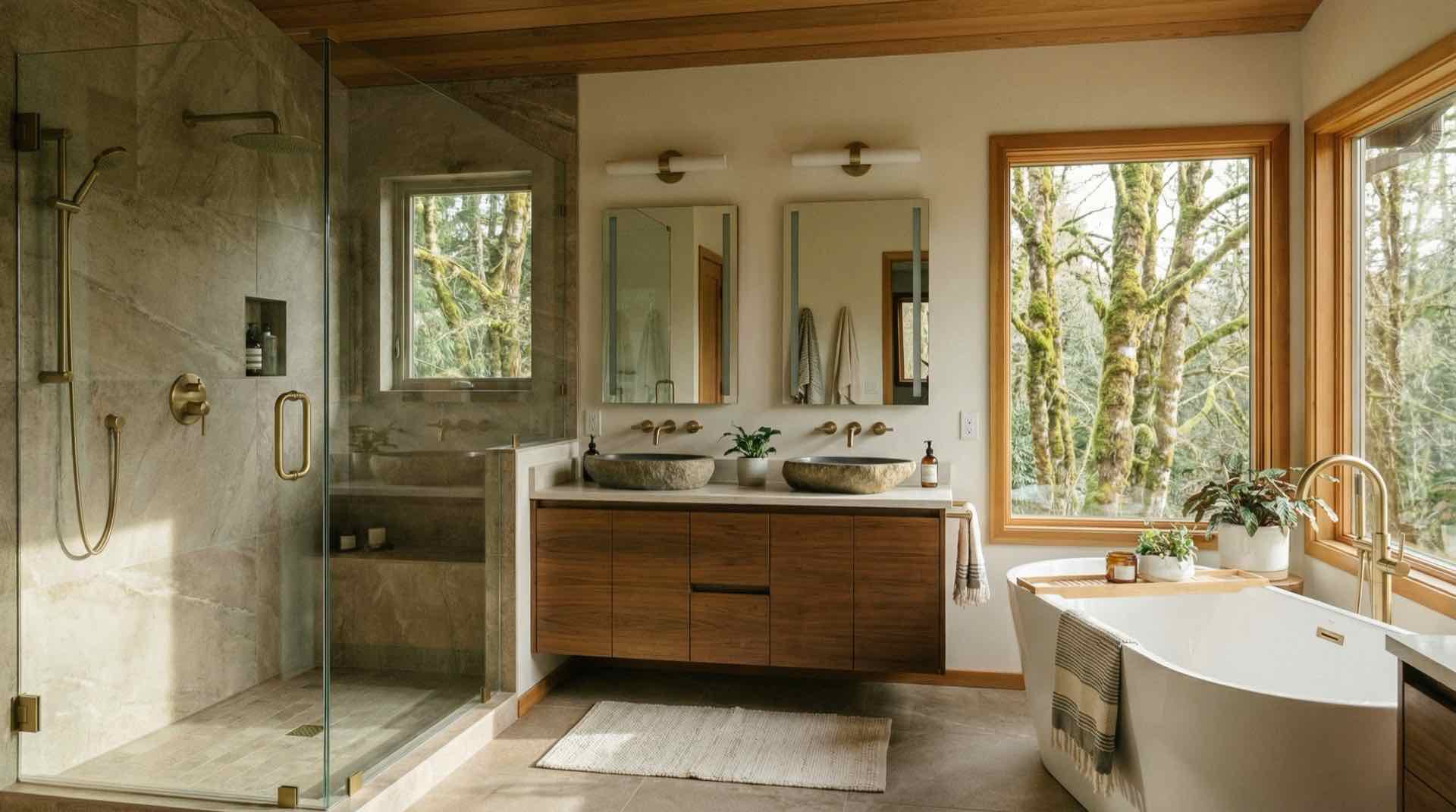
Floating vanities — also called wall-mounted or wall-hung vanities — have moved from boutique hotel bathrooms into mainstream residential remodeling. The NKBA 2026 Design Trends Report shows 62% of designers now specify wood-faced floating vanities in their bathroom projects, and 91% of homeowners rank durability as their top vanity selection criterion. For Vancouver, WA homeowners, a floating vanity offers a clean modern aesthetic, easier floor cleaning, and adjustable mounting height — but the cost picture is more nuanced than a simple product price tag.
This guide covers everything you need to know about floating vanity costs in 2026: unit pricing by tier, installation labor, countertop add-ons, tariff impacts on imported products, PNW moisture considerations, and the ROI case for upgrading your Vancouver-area bathroom.
Get a Vanity Installation Estimate
Thinking about a floating vanity for your bathroom? Our team provides free, no-pressure estimates for bathroom remodeling across Clark County.
Request a Free EstimateKey Takeaways
- Unit cost: $200 (budget) to $6,000+ (premium/custom) for the vanity alone (Homewyse, Fixr, 2026)
- Installation labor: $350–$900 for professional mounting, blocking, and plumbing hookup (Homewyse, 2026)
- Countertop add-on: $200–$1,500+ depending on material and size
- 2026 tariff impact: 25% Section 232 tariff and 50% China tariff are adding 15–30% to imported vanity prices
- Design trend: 62% of designers specify wood-faced floating vanities; 91% of homeowners prioritize durability (NKBA 2026)
- ROI: Bathroom remodels return 87.7% in the Pacific region (Remodeling Magazine, 2025)
What is a floating vanity?
A floating vanity is a bathroom cabinet that mounts directly to the wall with no legs touching the floor. The vanity is secured to wall studs or structural blocking using a heavy-duty cleat or bracket system, leaving open space underneath. Plumbing supply lines and drain connections route through the wall behind the unit.
Floating vanities come in single-sink widths (24–36 inches) and double-sink widths (48–72 inches). They range from simple open-shelf designs to fully enclosed cabinets with soft-close drawers. The mounting height is adjustable — typically set at 32–36 inches from the floor, though ADA-compliant installations can be lower.
Unlike traditional floor-standing vanities, floating models require wall reinforcement during installation. That structural requirement is the primary difference in both installation complexity and cost. For a full overview of bathroom renovation budgets, see our bathroom remodel cost guide for Vancouver, WA.
Floating Vanity Cost by Tier — 2026
Sources: Homewyse, Fixr.com, JLC/Zonda CVV 2025
Floating vanity cost breakdown by tier
Floating vanity prices vary widely based on materials, construction quality, and whether the unit is stock, semi-custom, or fully custom. The three tiers below cover the range you'll encounter from big-box retailers through custom cabinetmakers in the Vancouver area.
Budget tier: $200–$800
Budget floating vanities are typically MDF or particleboard construction with a melamine or thermofoil finish. They're available off the shelf at home improvement stores in standard widths (24–48 inches). Most include a basic ceramic or cultured marble top. Hardware is functional but not premium — expect cam-lock assembly and surface-mounted hinges.
These units work well for guest bathrooms, rental properties, or quick cosmetic updates where the goal is a modern look on a tight budget. Durability is the tradeoff: MDF core is susceptible to moisture damage if the finish is compromised, which is a real concern in the Pacific Northwest.
Mid-range tier: $800–$2,500
Mid-range floating vanities use plywood construction, hardwood or engineered-wood face frames, and soft-close drawer slides. Finish options expand to include painted wood, walnut veneer, white oak, and matte lacquer. Sizes range from 30 to 60 inches, and many semi-custom manufacturers offer depth and height modifications.
This tier delivers the best balance of aesthetics, durability, and cost. Plywood construction resists moisture far better than MDF, and the fit and finish reflect a higher design standard. For most Vancouver-area bathroom remodels, a mid-range floating vanity is the sweet spot.
Premium tier: $2,500–$6,000+
Premium and custom floating vanities feature solid hardwood or high-grade plywood with premium veneers, dovetail drawer joints, integrated LED lighting, and custom sizing to fit any wall width. Custom units are built to exact specifications by local or regional cabinetmakers. Lead times run 6–12 weeks.
The Grand View Research 2024 report projects the global bathroom vanity market to grow at 5.1% CAGR through 2030, driven by demand for custom and premium products. If your remodel is a master bathroom spa project, a custom floating vanity anchors the design.
How much does floating vanity installation cost?
Professional installation of a floating vanity runs $350–$900 in the Vancouver, WA area (Homewyse, 2026). That range covers wall preparation, blocking installation, vanity mounting, and plumbing hookup. The wide spread reflects differences in wall condition and whether new blocking is required.
| Installation task | Cost range | Notes |
|---|---|---|
| Wall blocking (new construction) | Included in framing | Blocking between studs at vanity height is standard in new builds |
| Retrofit blocking (existing wall) | $150–$350 | Requires opening drywall, adding 2x6 blocking, and patching — adds 2–4 hours |
| Vanity mounting & leveling | $150–$300 | Securing the cleat and vanity to wall studs or blocking |
| Plumbing hookup | $100–$250 | Connecting supply lines and P-trap; more if converting from floor-mounted to wall-mounted drain |
| Plumbing relocation | $500–$1,500+ | Required when switching from floor-standing to floating if drain exits through the floor |
The biggest installation cost variable is whether your existing wall has structural blocking. Homes built after 2010 often have blocking already in place for bathroom fixtures. Older Vancouver homes — especially pre-1990 construction — typically do not. Expect the retrofit blocking line item if your home is older.
What do countertops cost for a floating vanity?
Many budget and mid-range floating vanities ship with an integrated countertop and sink. Premium vanities often come as cabinet-only, requiring a separate countertop purchase. Here are typical countertop costs for bathroom vanities in 2026:
| Material | Cost (installed) | Best for |
|---|---|---|
| Cultured marble | $200–$600 | Budget projects; integrated sink option |
| Laminate | $150–$400 | Cost-conscious updates; wide color range |
| Quartz | $400–$1,200 | Mid to premium; non-porous and low-maintenance |
| Granite | $500–$1,200 | Natural stone aesthetic; requires sealing |
| Solid surface (Corian) | $350–$900 | Seamless look; repairable surface |
| Porcelain slab | $600–$1,500+ | Ultra-thin profile; pairs well with floating design |
Quartz is the most popular countertop material for bathroom vanities in 2026, according to the Houzz 2025 Bathroom Trends Study. Its non-porous surface is ideal for the high-humidity environment of PNW bathrooms.
2026 Floating Vanity Design Trends (NKBA / Houzz)
Sources: NKBA 2026 Design Trends, Houzz 2025 Bathroom Study
How are 2026 tariffs affecting floating vanity prices?
Two tariff actions are directly impacting bathroom vanity costs in 2026. The Section 232 tariff imposes a 25% duty on imported steel and aluminum, which affects vanity hardware, drawer slides, and mounting brackets. The broader 50% tariff on Chinese imports hits ready-to-assemble (RTA) vanities and budget models particularly hard, since approximately 70% of sub-$1,000 vanities sold in the U.S. originate from Chinese manufacturing (PBS News, 2025).
The practical effect on Vancouver homeowners:
- Budget vanities ($200–$800): Price increases of 20–30% on imported models. A vanity that was $500 in 2024 may now retail for $625–$650.
- Mid-range vanities ($800–$2,500): Mixed impact. Models with domestic manufacturing are less affected, while imported semi-custom lines have increased 10–15%.
- Premium vanities ($2,500+): Minimal direct tariff impact on custom-built and domestic premium lines. However, hardware components (soft-close mechanisms, brackets) have increased 5–10%.
The takeaway: domestically manufactured vanities are comparatively better values in 2026 than they were in previous years. If you're comparing a $1,200 imported vanity against a $1,400 domestic option, the gap is narrower than it was pre-tariff. For more on how tariffs are affecting cabinet and vanity costs, see our cabinet refacing vs. replacement cost guide.
Need Help Choosing the Right Vanity?
We'll walk through material options, mounting requirements, and pricing for your specific bathroom layout — no pressure, no obligation.
Request a Free Estimate2026 floating vanity design trends
The NKBA 2026 Design Trends Report and the Houzz 2025 Bathroom Trends Study reveal several clear directions for floating vanity design. Here's what's driving specifications in the Vancouver area and nationally.
- Wood-faced finishes dominate: 62% of designers now specify wood-faced floating vanities, up from 48% in 2024. White oak, walnut, and teak are the most specified species. The shift away from all-white bathrooms is accelerating.
- Durability over aesthetics: 91% of homeowners rank durability as their top vanity selection criterion (NKBA 2026). This favors plywood construction and marine-grade finishes over MDF, especially in the moisture-heavy PNW climate.
- Matte and natural finishes: Glossy lacquer is declining. Matte, satin, and natural oil finishes are preferred for their ability to hide water spots and fingerprints — a practical consideration in everyday use.
- Integrated LED lighting: Under-vanity LED strip lighting serves double duty as a design element and a nightlight. About 38% of new floating vanity installations include integrated lighting.
- Thin-profile countertops: Porcelain slab and ultra-compact surfaces (12mm thickness) pair with floating vanities for a minimal, clean-line look that emphasizes the wall-mounted silhouette.
For more design inspiration and cost data on high-end bathroom finishes, see our master bathroom spa remodel features and cost guide.
PNW moisture considerations for floating vanities
Vancouver, WA receives precipitation on 150+ days per year (NOAA, 2025). That ambient moisture, combined with daily shower steam, creates conditions where vanity material selection and installation quality directly determine how long your floating vanity lasts.
- Avoid MDF in wet areas: MDF core swells irreversibly when exposed to moisture. In the PNW climate, even a small finish crack can allow humidity to reach the core. Plywood or solid wood construction is the better investment for any bathroom that sees daily use.
- Marine-grade or exterior-grade plywood: For bathrooms adjacent to showers or in high-humidity spaces, specify marine-grade plywood for the vanity box. The cost premium is modest ($50–$150 more per vanity) and the moisture resistance is substantially better.
- Ventilation is non-negotiable: Washington State code requires a bathroom exhaust fan vented to the exterior. An undersized or poorly ducted fan accelerates moisture damage to all bathroom fixtures, including the vanity. Budget for a properly sized fan if your current one is inadequate.
- Sealed bottom edges: The underside of a floating vanity is exposed and visible. Quality manufacturers seal all edges — including the bottom — to prevent moisture wicking. Verify this before purchasing budget models.
- Wall-behind waterproofing: The wall area behind and below a floating vanity should be finished and sealed. Unlike floor-mounted vanities that hide the wall, floating designs expose it. Use moisture-resistant paint or tile on the wall section behind the vanity.
Cutting corners on moisture protection is a false economy in Clark County. A $1,200 vanity installed without proper ventilation and sealing may need replacement in 5–7 years. The same vanity in a well-ventilated bathroom with sealed edges lasts 15–20 years. Our energy-efficient remodeling guide covers ventilation systems and their impact on indoor air quality and material longevity.
Worried About Moisture in Your Bathroom?
Our team inspects for ventilation, water damage, and mold before every remodel. We'll recommend the right vanity construction for your specific space.
Schedule a Free ConsultationFloating vanity pros and cons
Floating vanities offer meaningful advantages, but they're not the right choice for every bathroom. Here's a clear comparison to help you decide.
Floating Vanity — Pros vs. Cons
Advantages
- +Easier floor cleaning — mop and vacuum under the vanity without obstruction
- +Small-bathroom visual trick — exposed floor makes the room feel larger
- +Adjustable height — mount at any height for comfort or ADA compliance
- +Modern design appeal — strong buyer preference in 2026 market
- +Leak visibility — plumbing leaks are visible immediately, not hidden inside a cabinet base
- +ADA / aging-in-place ready — wheelchair clearance underneath when mounted at proper height
Disadvantages
- –Wall reinforcement required — blocking adds $150–$350 in older homes
- –Less storage — no base cabinet below means fewer cubic inches of enclosed storage
- –Exposed plumbing — supply lines and P-trap are visible; requires clean routing or a wall-mount drain
- –Higher installation cost — $350–$900 vs. $100–$200 for a floor-standing unit
- –Weight limit — heavy countertops (thick granite slabs) may require additional support engineering
- –Dust and item accumulation — open space below collects items and dust if not kept clear
For bathrooms where storage is a primary concern, a floor-mounted vanity with deep drawers may be the better call. For small bathrooms, accessible designs, or modern aesthetics, floating vanities offer clear advantages. Our aging-in-place bathroom remodel guide covers ADA-compliant vanity mounting heights and clearance requirements in detail.
What is the ROI on a floating vanity bathroom remodel?
A midrange bathroom remodel returns approximately 73.7% nationally and 87.7% in the Pacific region, according to the 2025 Remodeling Magazine Cost vs. Value Report. That Pacific region figure is among the highest in the country, driven by strong housing demand in the Portland–Vancouver metro area.
A floating vanity specifically contributes to ROI in three ways:
- Modern buyer appeal: Floating vanities signal a contemporary, updated bathroom. In the 2025 Houzz study, bathrooms with floating vanities received higher satisfaction ratings from homeowners than those with traditional cabinets.
- Universal design value: Adjustable height and wheelchair clearance appeal to a broader buyer pool, including aging homeowners and families with accessibility needs.
- Photography and listing appeal: Floating vanities photograph well and read as “modern” in online real estate listings, which is where most buyers form their first impression.
A $3,000 floating vanity upgrade within a $25,000 bathroom remodel could contribute to roughly $21,900 in recovered value at resale in the Pacific region. The NKBA recommends spending 5–10% of your home's value on a bathroom remodel. For a $450,000 Vancouver-area home, that's $22,500–$45,000.
For a broader view of which renovations deliver the strongest payback, see our best home renovation ROI guide for Vancouver, WA. If you're also planning a kitchen update, our kitchen remodel cost guide covers cabinetry ROI in detail.
Do I need a permit to install a floating vanity in Vancouver, WA?
In most cases, replacing an existing vanity with a floating vanity on the same plumbing lines does not require a permit in Clark County. However, permits are required in these situations:
- Plumbing relocation: Moving the drain or supply lines from their current position requires a plumbing permit and inspection.
- New electrical work: Adding outlets, under-vanity lighting on a new circuit, or GFCI upgrades require an electrical permit.
- Structural modification: If installing blocking requires opening a load-bearing wall or modifying framing beyond simple blocking, a building permit may be needed.
Permit fees in Clark County range from $85–$250 for plumbing or electrical work. Unpermitted work carries penalties of $500–$1,000 initially, plus $100–$500 per day until resolved (Clark County Community Development). GVX handles all permitting and inspection scheduling when the project scope requires it.
For a detailed walkthrough of the permitting process, see our Vancouver, WA remodeling permits and inspections guide.
Frequently asked questions
How much does a floating vanity cost installed?
A floating vanity costs $200–$6,000+ for the unit, plus $350–$900 for professional installation. Budget models start at $200–$800, mid-range runs $800–$2,500, and premium or custom units range from $2,500 to $6,000 or more. Add $200–$1,500 for a countertop depending on material.
Can a floating vanity hold as much weight as a floor-mounted vanity?
Yes, when properly installed into wall studs or structural blocking. Most wall-mounted vanities support 200–300 pounds. A licensed installer will verify stud locations and add blocking if needed to ensure the vanity is anchored securely.
Are floating vanities good for small bathrooms?
Floating vanities are one of the best options for small bathrooms. The open floor space makes the room feel larger and allows light to travel across the floor. A 24-inch floating vanity in a half bath provides storage without overwhelming the space.
Do floating vanities work for aging-in-place bathrooms?
Yes. Floating vanities can be mounted at any height, making them ADA-adaptable. A wheelchair-accessible installation is typically set at 30–34 inches with open knee clearance below. See our aging-in-place bathroom remodel guide for full accessibility specifications.
How are 2026 tariffs affecting floating vanity prices?
The 25% Section 232 tariff on steel/aluminum and the 50% tariff on Chinese imports are raising imported floating vanity prices by 15–30%. Domestically manufactured vanities are less affected. Ordering early and considering U.S.-made options helps manage costs.
Do I need a permit to install a floating vanity in Clark County?
Replacing an existing vanity on the same plumbing lines does not require a permit. Moving plumbing supply or drain lines requires a plumbing permit. GVX handles all permitting when the project scope requires it. See our permits and inspections guide for details.
Sources & references
- Homewyse — 2026 Bathroom Vanity Installation Cost Calculator
- Fixr.com — 2026 Bathroom Vanity Installation Cost Guide
- Remodeling Magazine — 2025 Cost vs. Value Report (Pacific region)
- NKBA — 2026 Design Trends Report
- Houzz — 2025 Bathroom Trends Study
- Grand View Research — Bathroom Vanity Market Report 2024
- JLC/Zonda — Construction Cost Verification (CVV) 2025
- PBS News — Tariff Impact on Home Improvement Costs (2025)
- Clark County Community Development — Building Permits
- NOAA — Portland/Vancouver Climate Data (2025)
Written by
GVX Remodeling Team
Practical bathroom remodeling cost and design guidance from the GVX Remodeling team, helping Clark County homeowners make informed renovation decisions.