Master Bathroom Spa Remodel: Features, Costs & Design Guide (2026)
The master bathroom has become the most requested room for spa-style upgrades in 2026. According to the NKBA 2026 Design Trends Report, 77% of design professionals say hotel-inspired features — steam showers, heated floors, freestanding soaking tubs — are now standard requests, not luxury add-ons. This guide breaks down every major spa feature, what each one costs, the design trends shaping 2026 master baths, and how these upgrades perform at resale in the Vancouver, WA market.
Whether you're planning a full master bath remodel or want to add a few wellness features to your next bathroom renovation, this guide gives you the numbers and the context to make informed decisions.
Get a Spa Bathroom Estimate
Ready to transform your master bathroom into a personal retreat? Our team provides free, no-pressure estimates for spa bathroom remodeling across Clark County.
Request a Free EstimateKey Takeaways
- Spa features going mainstream: 77% of design pros report hotel-style cues are now standard requests (NKBA 2026)
- Most popular upgrades: Heated floors (54% top trend), steam showers (44%), and rainfall shower systems (43%) lead designer recommendations (Fixr 2026)
- Cost range: Budget spa add-ons start at $8,000; full spa master bath remodels run $30,000–$80,000+ (HomeGuide/This Old House 2026)
- ROI: Midrange bathroom remodels return 80% nationally, 87.7% in the Pacific region (Cost vs. Value 2025)
- Trend watch: 36% of renovated bathrooms now include at least one wellness feature (Houzz 2025)
Why Homeowners Are Turning Bathrooms Into Personal Spas
The pandemic-era focus on home wellness didn't fade — it accelerated. The NKBA 2026 Design Trends Report found that 77% of kitchen and bath designers now see hotel-style design cues as a common client request, up from niche territory just a few years ago. This isn't a coastal phenomenon — Clark County homeowners are making the same asks.
The data backs the shift. Houzz's 2025 Bathroom Trends Study reports that 36% of all renovated bathrooms now include at least one wellness feature — heated floors, steam functionality, chromotherapy lighting, or a soaking tub. That's more than one in three bathroom remodels incorporating elements that were considered high-end just five years ago.
Bathroom footprints are growing to accommodate these features. Roughly 75% of NKBA designers expect master bathroom square footage to increase in 2026 projects, driven by demand for larger showers, freestanding tubs, and dedicated wellness zones. In Vancouver, WA — where the median home price sits near $549,000 — homeowners renovating rather than moving are investing that equity into rooms they use every day.
Three factors are driving the spa bathroom trend in the Pacific Northwest specifically:
- Climate alignment: Vancouver averages 150+ days of rain annually. A steam shower or heated floor feels less like a luxury and more like a necessity from October through April.
- Locked-in mortgage rates: Most Washington homeowners hold sub-5% rates, so renovating the existing home beats buying new.
- Resale competition: As more buyers expect spa-quality master baths, homes without them face a competitive disadvantage in the $500K+ market segment.
Top Spa Features for Your Master Bathroom Remodel
Not all spa features carry the same cost, complexity, or buyer appeal. Below is a breakdown of the seven most requested spa upgrades, with installed cost ranges and the design data behind each one.
Steam Shower
Installed cost: $2,800–$10,000 (Angi, 2026)
Steam showers top the list for good reason: 44% of design professionals cite them as a leading bathroom trend in the Fixr 2026 Design Trends survey. The system works by adding a compact steam generator (typically small enough to fit inside a vanity cabinet or a closet up to 25 feet from the shower) that delivers therapeutic steam within minutes.
A steam shower requires a fully sealed, waterproof enclosure with a sloped ceiling to prevent dripping. The enclosure must use non-porous materials — porcelain, natural stone, or solid surface panels. Vapor barriers behind the walls are critical, especially in the Pacific Northwest where ambient humidity is already high.
Costs vary primarily based on the generator size (determined by shower cubic footage), the number of steam heads, and whether you add digital controls with temperature presets. A basic single-head system runs $2,800–$4,500 installed. Multi-head setups with digital panels, aromatherapy injection, and chromotherapy lighting push into the $6,000–$10,000 range.
For homeowners upgrading an existing shower remodel, adding steam functionality during the project is significantly cheaper than retrofitting later, since the waterproofing and ceiling slope are handled during construction.
Heated Floors (Radiant Floor Heating)
Installed cost: $500–$2,800 (Block Renovation, 2026)
Heated floors rank as the number-one spa trend in 2026, with 54% of design professionals recommending them per the Fixr survey. Electric radiant mats install beneath tile, stone, or luxury vinyl flooring and connect to a programmable thermostat.
The cost depends on floor area and system type. A typical master bathroom (60–120 sq ft) with electric radiant mats runs $500–$2,800 installed, including the thermostat. Hydronic (water-based) systems cost more but are typically reserved for whole-house installations rather than single-room retrofits.
Electric radiant mats add roughly 1/8 inch of height, so they rarely cause threshold issues. They draw 8–12 watts per square foot, adding approximately $15–$40 per month to your electric bill for a master bathroom in Clark County. Many homeowners program them to heat only during morning and evening hours to reduce costs.
Heated floors pair naturally with tile and stone — materials that feel cold in the PNW's eight-month cool season. For more on choosing the right flooring material for Pacific Northwest homes, see our best flooring for PNW homes guide.
Freestanding Soaking Tub
Installed cost: $4,000–$10,000+ (This Old House, 2026)
Freestanding soaking tubs appear in 18% of renovated bathrooms (Houzz, 2025), serving as both a functional wellness feature and a visual centerpiece. Unlike built-in alcove tubs, freestanding models require floor drain access and adequate structural support — a filled soaking tub can weigh 500–800 pounds.
Acrylic freestanding tubs start around $1,200–$3,000 for the fixture alone, while cast iron, stone resin, and copper options run $3,000–$8,000+. Installation adds $1,500–$3,000 for plumbing rough-in, drain relocation if needed, and a freestanding floor-mount filler faucet.
Japanese-style deep soaking tubs have surged in popularity. These are deeper and narrower than Western tubs, designed for full shoulder immersion while using less water. They work well in master baths where floor space is limited but ceiling height is adequate.
If you're debating between keeping a tub or going shower-only, our tub-to-shower conversion guide covers the pros and cons for resale in the Vancouver market.
Rainfall & Multi-Head Shower Systems
Installed cost: $1,500–$5,000
The Fixr 2026 survey found that 43% of design professionals identify smart and multi-function shower systems as a top trend. Rainfall showerheads mounted flush to the ceiling deliver a wide, gentle water pattern that mimics natural rain — a signature spa experience.
Multi-head systems combine a ceiling-mount rain head, a handheld wand, and body jets. Digital mixing valves let you save temperature and pressure presets. Basic rain head upgrades run $200–$800 installed if you already have the right valve infrastructure. Full multi-head systems with thermostatic valves, body sprays, and digital controls run $2,500–$5,000 installed.
Water pressure matters. Multi-head systems require a minimum 3/4-inch supply line; many older Vancouver, WA homes have 1/2-inch lines. A plumber can assess whether your existing supply can handle the added demand or if an upgrade is needed.
For a deeper look at shower remodeling options including walk-in showers, frameless glass, and tile patterns, see our dedicated service page.
Chromotherapy & Ambient Lighting
Installed cost: $500–$3,000
Chromotherapy uses colored LED lighting — typically embedded in shower walls, tub surrounds, or recessed ceiling fixtures — to create mood-specific lighting zones. Blue tones promote relaxation, warm amber mimics candlelight, and programmable cycles transition through multiple colors.
Basic LED strip systems with waterproof IP67 ratings start at $500–$800 installed. Integrated shower chromotherapy panels from brands like Kohler and ThermaSol run $1,200–$3,000. These often connect to the same digital control panel as the steam generator and shower system, allowing a single-touch “spa mode” activation.
Layered lighting design is key. Combine chromotherapy with dimmable recessed lighting and backlit mirrors for a spa effect that also works for everyday tasks like shaving and makeup application.
Aromatherapy & Sound Systems
Installed cost: $200–$1,500
Aromatherapy modules inject essential oils (eucalyptus, lavender, peppermint) directly into the steam line of a steam shower. Standalone aromatherapy dispensers integrate into ventilation systems for non-steam bathrooms. Costs for aromatherapy modules range from $200–$500 as an add-on to a steam system.
In-ceiling or in-wall Bluetooth speakers designed for wet environments run $200–$1,000 per pair installed. Moisture-rated speakers (IP65+) are essential in shower and steam environments. Brands like Sonos, Bose, and SteamSpa offer dedicated bathroom audio solutions that connect to existing smart home ecosystems.
These are low-cost, high-impact features. A $400 aromatherapy module and a $500 speaker pair can transform the sensory experience of a bathroom without adding significant project cost.
Smart Toilets & Bidet Features
Installed cost: $1,500–$8,000
Integrated smart toilets with bidet functionality, heated seats, warm air dryers, automatic lids, deodorizers, and nightlights have moved from niche to mainstream. Entry-level bidet seats (Tushy, Brondell) add bidet functionality to an existing toilet for $300–$800 installed. Full smart toilets from TOTO, Kohler, and Duravit with integrated wash, dry, and deodorize systems run $3,000–$8,000 installed.
Smart toilets require a nearby GFI outlet, which most older bathrooms lack. Running a new electrical circuit adds $200–$500 to the install. Some models offer self-cleaning UV sterilization and automatic flush, reducing maintenance.
In the Pacific Northwest, water-conscious features resonate with buyers. Dual-flush smart toilets use as little as 0.8 GPF on the low setting, significantly below the federal 1.6 GPF maximum. For more on energy-efficient remodeling approaches including water savings, see our dedicated guide.
Spa Bathroom Design Trends for 2026
Features alone don't make a spa bathroom. The overall design — materials, layout, and accessibility — determines whether the room feels like a retreat or just a bathroom with expensive fixtures.
Natural Materials & Biophilic Design
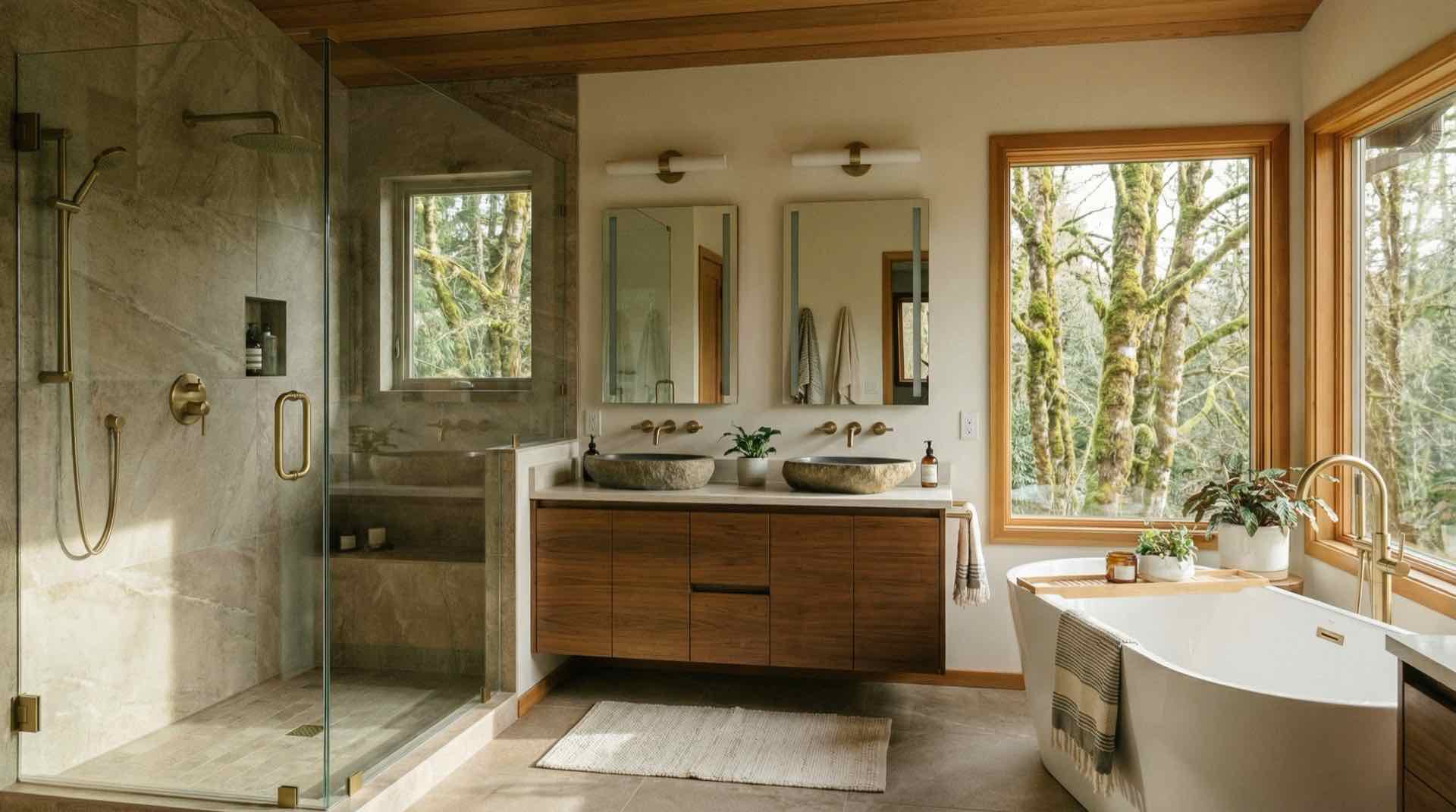
Biophilic design brings natural elements indoors to promote calm and connection to the outdoors. In spa bathrooms, this translates to natural stone (marble, travertine, slate), wood-look porcelain tile, live-edge wood vanity tops, and integrated planter niches.
Warm earth tones are replacing the all-white bathroom. Designers are specifying fluted stone, brushed brass or matte gold hardware, and large-format stone-look porcelain slabs that minimize grout lines. The goal is a seamless, organic aesthetic — fewer visual interruptions, more texture.
Living walls and shower niches with small plants (ferns, pothos, air plants) are becoming common in high-end spa baths. The PNW climate is ideal for humidity-loving plants, and a bathroom with natural light and steam creates a mini greenhouse effect.
Material selection matters for longevity. In Clark County's humid environment, natural stone requires annual sealing to prevent moisture damage. Porcelain alternatives that mimic stone offer the aesthetic with lower maintenance. See our flooring guide for PNW homes for material comparisons.
Wet Room & Curbless Shower Layouts
Wet rooms — open-concept shower areas without curbs, doors, or enclosures — appear in 16% of renovated bathrooms, per Houzz (2025). The entire floor is waterproofed and sloped to a linear drain, creating a seamless transition from the main bathroom into the shower zone.
Wet rooms require precision waterproofing. A full wet room waterproofing system (Schluter Kerdi, Laticrete Hydro Ban, or similar) adds $1,500–$3,000 to a standard shower build. The investment prevents the moisture intrusion that is especially problematic in the Pacific Northwest. Done right, a wet room eliminates the curb-step hazard, visually expands the space, and provides the open spa aesthetic that drives current design trends.
Curbless showers are a subset of wet room design and overlap heavily with accessibility features. A zero-threshold entry makes the shower wheelchair and walker accessible without looking like a medical installation. This dual benefit — spa aesthetic plus universal access — makes curbless layouts one of the smartest investments in a 2026 master bath.
Accessibility as Luxury
The NKBA 2026 report found that 80% of designers now consider aging-in-place features mainstream, not niche. The framing has shifted: grab bars, comfort-height toilets, bench seating, and walk-in tubs are being marketed as “spa safety” rather than “elderly accommodations.”
Decorative grab bars in brushed nickel, matte black, or brass finishes blend into spa aesthetics while providing the support needed for aging in place. Linear shower benches in matching stone or tile double as design elements. Comfort-height toilets (17–19 inches) are now the default in master baths regardless of the homeowner's age.
This convergence of accessibility and luxury design is especially relevant for Vancouver, WA homeowners who plan to stay in their homes long-term. Adding these features during a spa remodel costs a fraction of retrofitting them later. For a detailed guide to ADA-compliant and senior-friendly bathrooms, visit our dedicated page. Our walk-in bathtub options combine spa soaking with accessibility for homeowners who need a step-in solution.
Spa Feature Cost Ranges (Installed)
Sources: Angi, Block Renovation, This Old House (2026)
How Much Does a Spa Master Bathroom Remodel Cost?
Costs depend on whether you're adding spa features to an existing remodel or building a dedicated spa master bath from the ground up. Here's how the numbers break down by tier.
Cost Tiers: Budget, Mid-Range & Luxury
| Tier | Cost Range | What's Included |
|---|---|---|
| Budget Spa Add-ons | $8,000 – $15,000 | Heated floors, rainfall showerhead, basic chromotherapy LED strips, Bluetooth speakers. Added to an existing remodel budget. |
| Mid-Range Spa Bath | $30,000 – $50,000 | Steam shower, heated floors, freestanding acrylic soaking tub, multi-head shower, ambient lighting, updated vanity and tile. Full remodel with spa features integrated. |
| Luxury Spa Suite | $50,000 – $80,000+ | Wet room layout, premium steam system with aromatherapy, stone soaking tub, full multi-head digital shower, smart toilet, chromotherapy, in-wall sound, heated floors and towel warmers, custom natural stone finishes. |
Source: HomeGuide and This Old House 2026 bathroom remodel cost data. Master bath remodels without spa features average $12,000–$25,000 nationally, placing spa upgrades as a $15,000–$55,000+ premium on top of a standard renovation. For a detailed cost breakdown of standard master bathroom remodeling, see our bathroom remodel cost guide.
Spa Feature Cost Breakdown
| Feature | Low End | High End | Source |
|---|---|---|---|
| Steam shower (installed) | $2,800 | $10,000 | Angi 2026 |
| Heated floors (electric radiant) | $500 | $2,800 | Block Renovation 2026 |
| Freestanding soaking tub | $4,000 | $10,000+ | This Old House 2026 |
| Rainfall/multi-head shower | $1,500 | $5,000 | Industry avg. |
| Chromotherapy lighting | $500 | $3,000 | Industry avg. |
| Aromatherapy & sound | $200 | $1,500 | Industry avg. |
| Smart toilet / bidet | $1,500 | $8,000 | Industry avg. |
Vancouver, WA Cost Considerations
Clark County labor rates run 5–15% above the national average for skilled trades like plumbing, electrical, and tile work. Several factors push spa bathroom costs higher in Vancouver, WA specifically:
- Moisture management: PNW humidity demands higher-grade waterproofing membranes, vapor barriers, and ventilation systems. Budget an extra $1,000–$3,000 for proper moisture protection compared to drier climates.
- Permitting: Clark County requires permits for plumbing modifications, new electrical circuits (steam generators, heated floors, smart toilets all need dedicated circuits), and structural changes. Permit fees typically run $500–$2,000 depending on project scope.
- Material availability: Specialty spa fixtures (steam generators, premium smart toilets, stone soaking tubs) often ship from manufacturer rather than stocking locally, adding 2–6 weeks of lead time to the project timeline.
- No sales tax advantage: Washington state sales tax of 8.4% in Clark County applies to all materials, adding meaningful cost on a $30,000+ project.
For context on how spa bathroom costs fit within a broader home renovation, see our whole-house remodel cost guide and our guidance on choosing a remodeling contractor in the Vancouver area.
Bathroom Remodel ROI — Midrange vs. Upscale
Source: 2025 Cost vs. Value Report (Zonda/Remodeling Magazine)
What Design Experts Recommend — Top Spa Trends (Fixr 2026)
Source: Fixr 2026 Bathroom Design Trends Survey
ROI: Do Spa Features Pay Off at Resale?
A midrange bathroom remodel returns approximately 80% of its cost nationally, according to the 2025 Cost vs. Value Report. In the Pacific region — which includes Washington state — that number jumps to 87.7%. Vancouver, WA sits in the sweet spot for bathroom remodel ROI.
Spa features add a layer of complexity to the ROI calculation. They don't have their own line item in appraisal reports the way a new roof or kitchen does. Instead, they contribute to overall perceived quality and market positioning. In the $500K+ market segment — where Clark County median homes sit — spa master baths are increasingly expected rather than exceptional.
The practical ROI case for spa features comes down to competitive positioning. If three comparable homes are listed in the same neighborhood and one has a spa master bath with steam shower, heated floors, and a freestanding tub, that listing will draw more attention and potentially sell faster. Days on market is its own form of ROI.
The best ROI strategy: invest in features that are visible, experiential, and hard to add later. Heated floors and steam showers check all three boxes. A $5,000 steam shower addition to a $30,000 remodel won't hurt your overall ROI and may improve it by positioning your home in a higher competitive tier. For more on renovation ROI data, see our best home renovation ROI guide.
Planning Your Spa Bathroom Remodel: Timeline & Process
A full spa master bathroom remodel follows a predictable timeline, though spa-specific features add steps that a standard remodel doesn't require.
| Phase | Duration | Key Activities |
|---|---|---|
| Design & planning | 4–8 weeks | Layout design, feature selection, material sourcing, permit applications |
| Demolition | 3–5 days | Remove existing fixtures, inspect subfloor and framing for moisture damage |
| Rough plumbing & electrical | 1–2 weeks | Run supply/drain lines, install steam generator connections, heated floor wiring, GFI circuits for smart toilets |
| Waterproofing | 3–5 days | Membrane application, cure time, flood testing (critical for wet rooms and steam showers) |
| Tile & stone installation | 1–3 weeks | Floor tile over radiant mats, shower walls, accent features, grout and seal |
| Fixture installation | 3–5 days | Tub, shower system, smart toilet, vanity, lighting, mirrors |
| Final details & inspection | 3–5 days | Steam system commissioning, heated floor programming, final plumbing and electrical inspection, punch list |
Total construction timeline: 8–14 weeks for a full spa master bath remodel. Projects with structural changes, custom stone fabrication, or specialty fixture back-orders trend toward 14+ weeks. Planning and design add 4–8 weeks before construction begins, so budget 3–6 months total from first consultation to final walkthrough.
One scheduling note for the PNW: many homeowners prefer to start construction in late spring or summer when outdoor air helps with ventilation during demolition and waterproofing cure times. If you want your spa bathroom ready for fall and winter use, begin the design phase in January or February.
Frequently Asked Questions
How much does a spa-style master bathroom remodel cost in Vancouver, WA?
A spa-style master bathroom remodel in Vancouver, WA typically costs $30,000 to $80,000 or more, depending on the features selected. Budget spa upgrades (heated floors + rainfall shower) start around $8,000-$15,000 when added to an existing remodel. A full luxury spa master bath with steam shower, freestanding tub, heated floors, and smart fixtures can exceed $80,000.
What is the ROI on a master bathroom remodel?
A midrange bathroom remodel returns about 80% nationally and up to 87.7% in the Pacific region, according to the 2025 Cost vs. Value Report. Spa features like heated floors and steam showers are increasingly expected by buyers in higher-end markets, making them a competitive advantage rather than a luxury.
Are steam showers worth the investment?
Steam showers cost $2,800 to $10,000 installed and are cited as a top bathroom trend by 44% of design professionals (Fixr 2026 survey). They add perceived luxury that appeals to buyers in the $500K+ market segment. The generator requires minimal space (typically fits inside a vanity cabinet) and uses less water than a standard shower.
How long does a spa bathroom remodel take?
A full spa master bathroom remodel typically takes 8 to 14 weeks from demolition to final inspection. Projects involving structural changes, plumbing relocation, or custom tile work trend toward the longer end. Planning and design add 4 to 8 weeks before construction begins.
Can I add spa features to my existing bathroom without a full remodel?
Yes. Heated floor mats ($500-$2,800), a rainfall showerhead ($200-$800), chromotherapy LED lighting ($500-$1,500), and a Bluetooth speaker system ($200-$500) can all be retrofitted into an existing bathroom. A steam shower generator requires a fully enclosed shower space, which may need modifications if your current shower is not sealed.
Sources & References
- Remodeling Magazine — 2025 Cost vs. Value Report (National & Pacific Region)
- NKBA — 2026 Design Trends Report
- Houzz — 2025 Bathroom Trends Study
- Fixr — 2026 Bathroom Design Trends Survey
- Angi — 2026 Steam Shower Cost Guide
- Block Renovation — 2026 Heated Bathroom Floor Cost
- This Old House — 2026 Freestanding Tub Cost
- HomeGuide — 2026 Master Bathroom Remodel Cost Data
Written by
GVX Remodeling Team
Spa bathroom remodeling guidance from the GVX Remodeling team, helping Clark County homeowners design master bathrooms that combine daily function with wellness and long-term value.